 Lavik
LAVIK 0.2.0 · 2026-10-21
Lavik vs Redis-Compatible Databases on SSD
Compare Lavik with Dragonfly, Garnet, Apache Kvrocks, Pika and Tendis using their SSD-backed storage paths: one billion keys, a 1.024 TB raw value payload, matched concurrency and p99.9 curves.
1B keys × 1 KiB · 16 vCPUs · six NVMe SSDs · SPDK vs RAID0/XFS · 32 client threads · 160–1280 connections · 60 s per point
Lavik records the highest GET and SET sweep peaks: 1,129,597 and 910,356 QPS. At 320 connections, it delivers 652,881 GET QPS at 0.943 ms p99.9 and 701,241 SET QPS at 0.959 ms.
Test conditions and interpretation
Garnet leads GET at 160 connections: 419,982 versus Lavik’s 375,966 QPS. Lavik has the lowest p99.9 at every matched GET/SET point in this run. Memory budgets, warmups and persistence differ. One measured run per point; 1 TB excludes keys and storage/index overhead.
From setup to results: reproduction roadmap
- Install all six pinned releases and memtier 2.5.1. Use one database at a time on the same 16-vCPU server with a separate client.
- Verify dedicated empty devices. Prepare SPDK and 8 GiB hugepages for Lavik; use the report’s RAID0/XFS setup for filesystem peers.
- Save the Kvrocks/Pika/Tendis override blocks as named files and apply the supplied overlay script to their release configuration templates.
- Load one billion keys independently per system. Apply the specified Dragonfly/Garnet warmup, sweep 160–1280 connections, and reconcile sampled lengths, successful operations, misses and errors.
The full report below includes release versions, host conditions, server configurations, loading, warmup, measurement and validation commands. Paths, addresses and PCI identities describe the measured environment; adapt them before use. Format or clear only verified empty, dedicated test devices.
At the same 320 connections
One billion keys × 1 KiB. Throughput and p99.9 come from the same measured point. The full sweep and selected peaks follow in the report.
QPS · higher is better
| System | GET QPS | GET p99.9 (ms) | SET QPS | SET p99.9 (ms) |
|---|---|---|---|---|
| Lavik 0.2.0 | 652,881 | 0.943 | 701,241 | 0.959 |
| Garnet 2.2.1 | 253,433 | 7.167 | 668,406 | 4.415 |
| Dragonfly 2.0.2 | 469,604 | 17.023 | 517,357 | 14.143 |
| Pika 3.5.7 | 202,391 | 4.191 | 94,438 | 8.831 |
| Apache Kvrocks 2.17.0 | 73,587 | 8.383 | 114,683 | 6.047 |
| Tendis 2.8.4 | 121,240 | 4.831 | 137,471 | 7.999 |
Lavik, Dragonfly, Garnet, Kvrocks, Pika and Tendis were freshly measured on a new Azure Standard_L16aos_v4. Each independently loads 1B keys × 1 KiB values (953.67 GiB logical value payload). All 48 formal points are complete. The eight Lavik points are shared with this batch’s in-memory database comparison report; the five peers each have a separate fresh load and measurement.
UTC: 2026-10-21T16:55:31.378000+00:00 – 2026-10-22T01:26:24.735000+00:00.
In this run, Lavik has the highest GET and SET sweep peaks, but Garnet leads GET throughput at 160 connections (419,982 versus 375,966 ops/s). Lavik has the lowest p99.9 at every matched GET/SET connection count; at 160 connections, GET p99.9 is 0.823 ms versus Garnet’s 2.687 ms. These observations apply to this single measured run and the stated configurations.
Throughput and p99.9 latency
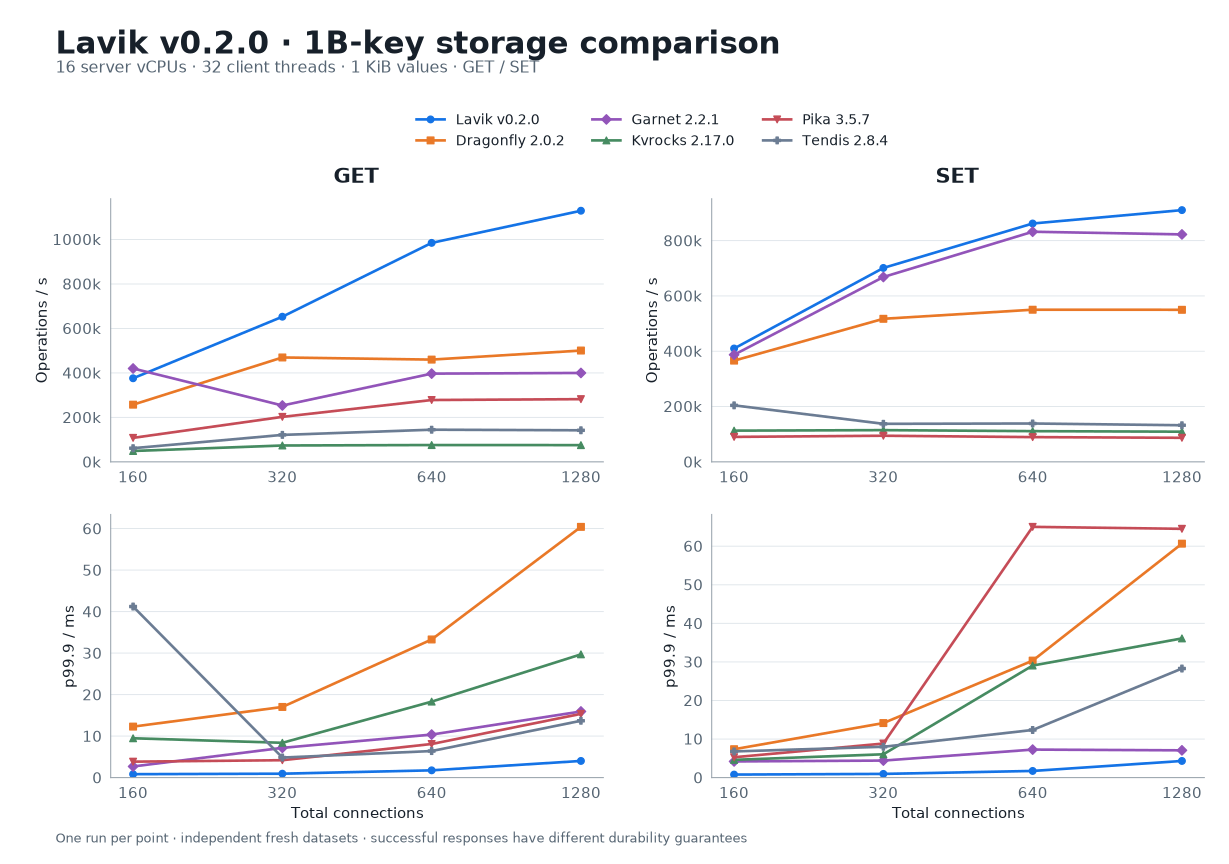
| Command | Product | Peak connections | Peak ops/s | p99.9 ms |
|---|---|---|---|---|
| GET | Lavik v0.2.0 | 1280 | 1,129,597 | 4.015 |
| GET | Dragonfly 2.0.2 | 1280 | 500,682 | 60.415 |
| GET | Garnet 2.2.1 | 160 | 419,982 | 2.687 |
| GET | Kvrocks 2.17.0 | 640 | 75,639 | 18.303 |
| GET | Pika 3.5.7 | 1280 | 281,975 | 15.359 |
| GET | Tendis 2.8.4 | 640 | 144,571 | 6.399 |
| SET | Lavik v0.2.0 | 1280 | 910,356 | 4.319 |
| SET | Dragonfly 2.0.2 | 640 | 550,147 | 30.335 |
| SET | Garnet 2.2.1 | 640 | 832,135 | 7.263 |
| SET | Kvrocks 2.17.0 | 320 | 114,683 | 6.047 |
| SET | Pika 3.5.7 | 320 | 94,438 | 8.831 |
| SET | Tendis 2.8.4 | 160 | 204,258 | 6.783 |
Peaks may occur at different connection counts. The matched-concurrency table shows ops/s / p99.9 ms.
| Command | Connections | Lavik v0.2.0 | Dragonfly 2.0.2 | Garnet 2.2.1 | Kvrocks 2.17.0 | Pika 3.5.7 | Tendis 2.8.4 |
|---|---|---|---|---|---|---|---|
| GET | 160 | 375,966 / 0.823 | 257,252 / 12.287 | 419,982 / 2.687 | 48,895 / 9.471 | 107,938 / 3.839 | 61,462 / 41.215 |
| GET | 320 | 652,881 / 0.943 | 469,604 / 17.023 | 253,433 / 7.167 | 73,587 / 8.383 | 202,391 / 4.191 | 121,240 / 4.831 |
| GET | 640 | 985,019 / 1.751 | 459,905 / 33.279 | 396,838 / 10.367 | 75,639 / 18.303 | 278,178 / 8.095 | 144,571 / 6.399 |
| GET | 1280 | 1,129,597 / 4.015 | 500,682 / 60.415 | 399,895 / 15.935 | 75,255 / 29.695 | 281,975 / 15.359 | 141,987 / 13.695 |
| SET | 160 | 409,886 / 0.783 | 366,038 / 7.359 | 387,296 / 4.191 | 112,843 / 4.607 | 90,218 / 5.279 | 204,258 / 6.783 |
| SET | 320 | 701,241 / 0.959 | 517,357 / 14.143 | 668,406 / 4.415 | 114,683 / 6.047 | 94,438 / 8.831 | 137,471 / 7.999 |
| SET | 640 | 861,911 / 1.727 | 550,147 / 30.335 | 832,135 / 7.263 | 111,034 / 29.055 | 89,450 / 65.023 | 138,691 / 12.351 |
| SET | 1280 | 910,356 / 4.319 | 549,937 / 60.671 | 822,427 / 7.071 | 109,065 / 36.095 | 86,950 / 64.511 | 132,374 / 28.287 |
Client and memory diagnostics
| Product | Max average client CPU / cores | Max thread average / cores | Post-point RSS / MiB | Max server steal / % |
|---|---|---|---|---|
| Lavik v0.2.0 | 17.971 | 0.579 | 47,998–48,012 | 0.0000 |
| Dragonfly 2.0.2 | 12.166 | 0.450 | 86,260–95,177 | 0.0000 |
| Garnet 2.2.1 | 15.661 | 0.511 | 115,481–115,830 | 0.0000 |
| Kvrocks 2.17.0 | 2.598 | 0.134 | 35,740–50,235 | 0.0000 |
| Pika 3.5.7 | 6.455 | 0.349 | 34,770–58,832 | 0.0000 |
| Tendis 2.8.4 | 4.456 | 0.164 | 45,683–79,879 | 0.0000 |
The client budget is 32 CPUs. RSS ranges use post-point process snapshots; Lavik additionally reserves 8 GiB hugepages.
Environment, configuration and method
| Item | Configuration |
|---|---|
| Server | Standard_L16aos_v4; Japan East zone 2; AMD EPYC 9V74; 8 physical / 16 logical CPUs; 128 GiB nominal RAM |
| Client | Standard_F32als_v6; memtier 2.5.1; 32 threads on CPUs 0–31 |
| OS | Ubuntu 24.04; Linux 6.17.0-1022-azure on both hosts |
| Storage | 6 × 1,919,850,381,312 B local NVMe; Lavik SPDK; peers RAID0/XFS/noatime |
| Network | Private VNet; kernel TCP; accelerated networking; data address 10.96.1.4 |
| Workload | Decimal keys 1..1,000,000,000; 1,024-byte values; random GET or overwriting SET; independent client seeds |
| Window | 60 seconds per point; 32 client threads; 160 / 320 / 640 / 1280 connections |
Products run sequentially, one independently loaded dataset each. GET precedes SET; concurrency increases within each sweep. Dragonfly and Garnet receive an additional 180-second GET warmup at 160 connections using 32 threads; other products follow the original method without that warmup. Builds finish before measurement. Every formal point has zero connection errors and every formal GET has zero misses. Each fill completes exactly one billion SET requests; value lengths are sampled before and after the sweep.
Lavik defrag stays enabled. Garnet uses Lookup compaction; RocksDB automatic compaction remains enabled. Configured memory budgets differ: Dragonfly 96 GiB; Garnet 64 GiB log, 32 GiB read cache and 16 GiB index; Kvrocks 80 GiB block cache; Pika 24 GiB block cache and 32 GiB application cache; Tendis 72 GiB shared cache. These are budgets, not measured total RSS.
Persistence differs: Lavik uses SPDK storage; Dragonfly has a tiered file without periodic snapshots; Garnet has a storage log without AOF; Kvrocks and Tendis disable WAL, and Pika disables binlog. Successful responses do not imply equal synchronous durability guarantees. One measured run per point; no confidence intervals. The historical 1B test used 16 client threads and included 80 connections; this run uses 32 threads and four connection counts, with the additional Dragonfly/Garnet warmup also changed to 32 threads and 160 connections. The new hosts use Japan East, while the historical run used Japan West.
Peer releases are unchanged from the v0.1.0 report: Dragonfly 2.0.2, Garnet 2.2.1 with .NET 10.0.12, Kvrocks 2.17.0, Pika 3.5.7 and Tendis 2.8.4-rocksdb-v8.5.3. The official Pika archive reports embedded version 3.5.6, revision 62a57f85534198e0d1033c32f1215c958bef8a5e.
Load receipts
| Product | Client invocation wall time / min | Reported fill ops/s |
|---|---|---|
| Lavik v0.2.0 | 21.6 | 940,654 |
| Dragonfly 2.0.2 | 24.4 | 820,369 |
| Garnet 2.2.1 | 25.3 | 798,058 |
| Kvrocks 2.17.0 | 112.8 | 163,321 |
| Pika 3.5.7 | 208.5 | 82,423 |
| Tendis 2.8.4 | 82.6 | 209,462 |
All points · Provenance · Validation · Raw logs and receipts
Load wall time includes connection setup, client-side statistics aggregation and result transfer.
Run commands
Use Bash and adjust addresses and installation paths. Install the release packages above and memtier 2.5.1. Run one server at a time; each startup command below stays in the foreground. Stop it cleanly before starting the next product. The filesystem setup uses only six verified empty scratch devices. For Lavik, use the SPDK storage guide to prepare its dedicated devices and 8 GiB hugepages before its independent load.
The configuration blocks contain overrides to the tested release templates. Save each block as the named .overrides file, then apply it with the supplied overlay script. The client workload is the same for all products.
Storage and paths
# Filesystem peers: six verified, empty local NVMe devices, kernel driver bound.
# These names are placeholders: replace each with a verified scratch device.
DEVICES=(/dev/TEST_NVME1 /dev/TEST_NVME2 /dev/TEST_NVME3
         /dev/TEST_NVME4 /dev/TEST_NVME5 /dev/TEST_NVME6)
sudo mdadm --create /dev/md/bench --level=0 --raid-devices=6 "${DEVICES[@]}"
sudo mkfs.xfs /dev/md/bench
sudo mkdir -p /mnt/bench020
sudo mount -o noatime /dev/md/bench /mnt/bench020
sudo mkdir -p /mnt/bench020/{dragonfly,garnet,kvrocks,pika/{db,log,dump,dbsync},tendis/{db,log,dump}}
sudo chown -R "$(id -u):$(id -g)" /mnt/bench020
ulimit -n 65535
Lavik SPDK
# Prepare the six verified SPDK namespaces using the SPDK storage guide.
# Use the actual PCI addresses after binding the empty scratch devices to VFIO.
BDFS=(7133:00:00.0 10fc:00:00.0 9c4a:00:00.0 ef09:00:00.0 fa44:00:00.0 9816:00:00.0)
FILES=(); EAL=''
for bdf in "${BDFS[@]}"; do
  FILES+=(--data-file="spdk://${bdf}/1")
  EAL+=" -a ${bdf}"
done
sudo prlimit --memlock=unlimited:unlimited --nofile=65535:65535 env BYCORF_EAL_ARGS="$EAL" BYCORF_DPDK_MEMORY_MB=8192 \
  taskset -c 0-15 /opt/lavik-v0.2.0-linux-x86_64/lavik \
  --storage=spdk --bind=10.96.1.4 --shutdown-checkpoint --tomb-raider-interval-ms=0 \
  --spdk-max-completions-per-poll=16 --log-dir=/mnt/dev/bench-lavik-logs \
  "${FILES[@]}"
Dragonfly 2.0.2
taskset -c 0-15 /opt/dragonfly/dragonfly-x86_64 \
  --logtostderr --bind=10.96.1.4 --proactor_threads=16 --maxmemory=96GB \
  --dir=/mnt/bench020/dragonfly --dbfilename= \
  --tiered_prefix=/mnt/bench020/dragonfly/tier \
  --tiering_disk_storage_initial_size=64GB --tiered_max_file_size=2TB \
  --backing_file_direct=false --tiered_offload_threshold=1.0 \
  --tiered_experimental_cooling=false --tiered_max_pending_stash_bytes=16MB
Garnet 2.2.1
cd /opt/garnet/net10.0
export DOTNET_ROOT=/opt/dotnet
export LD_LIBRARY_PATH="$PWD${LD_LIBRARY_PATH:+:$LD_LIBRARY_PATH}"
# The release archive places its native device library at the package root.
mkdir -p runtimes/linux-x64/native
ln -sf ../../../libnative_device.so runtimes/linux-x64/native/libnative_device.so
ln -sf /lib/x86_64-linux-gnu/libaio.so.1t64 libaio.so.1

taskset -c 0-15 ./GarnetServer \
  --bind 10.96.1.4 --protected-mode false --memory 64g --page 4m \
  --index 16g --index-max-size 16g --storage-tier \
  --logdir /mnt/bench020/garnet/log --checkpointdir /mnt/bench020/garnet/checkpoints \
  --readcache --readcache-memory 32g --no-obj --no-pubsub \
  --device-type Native --device-io-backend Libaio --device-throttle-limit 512 \
  --initial-io-record-size 8k --compaction-freq 300 --compaction-type Lookup \
  --compaction-force-delete --minthreads 16 --miniothreads 16
Kvrocks
# kvrocks.overrides
bind 10.96.1.4
port 6379
workers 16
tcp-backlog 8192
db-name kvrocks-perf
dir /mnt/bench020/kvrocks
log-dir stdout:warning
log-level warning
slowlog-log-slower-than -1
slowlog-max-len 0
persist-cluster-nodes-enabled no
enable-blob-cache yes
rocksdb.block_cache_size 81920
rocksdb.max_open_files -1
rocksdb.write_buffer_size 512
rocksdb.target_file_size_base 512
rocksdb.max_write_buffer_number 8
rocksdb.min_write_buffer_number_to_merge 2
rocksdb.max_background_jobs 16
rocksdb.max_subcompactions 4
rocksdb.max_total_wal_size 8192
rocksdb.wal_ttl_seconds 3600
rocksdb.wal_size_limit_mb 65536
rocksdb.compression no
rocksdb.compression_start_level 0
rocksdb.enable_pipelined_write yes
rocksdb.level0_file_num_compaction_trigger 16
rocksdb.level0_slowdown_writes_trigger 128
rocksdb.level0_stop_writes_trigger 256
rocksdb.enable_blob_files yes
rocksdb.min_blob_size 1000
rocksdb.blob_file_size 1073741824
rocksdb.level_compaction_dynamic_level_bytes no
rocksdb.max_bytes_for_level_base 68719476736
rocksdb.write_options.disable_wal yes
rocksdb.rate_limiter_auto_tuned no
Pika
# pika.overrides
port : 6379
thread-num : 16
thread-pool-size : 32
log-path : /mnt/bench020/pika/log/
db-path : /mnt/bench020/pika/db/
dump-path : /mnt/bench020/pika/dump/
pidfile : /mnt/bench020/pika/pika.pid
db-sync-path : /mnt/bench020/pika/dbsync/
max-subcompactions : 4
write-binlog : no
max-write-buffer-size : 8G
compression : none
max-background-jobs : 12
max-background-flushes : 4
max-background-compactions : 8
block-cache : 24G
num-shard-bits : 6
share-block-cache : yes
cache-index-and-filter-blocks : yes
pin_l0_filter_and_index_blocks_in_cache : yes
optimize-filters-for-hits : yes
cache-maxmemory : 34359738368
Tendis
# tendis.overrides
bind 10.96.1.4
port 6379
daemon off
logLevel warning
logdir /mnt/bench020/tendis/log
dumpdir /mnt/bench020/tendis/dump
dir /mnt/bench020/tendis/db
pidfile /mnt/bench020/tendis/tendisplus.pid
slowlog /mnt/bench020/tendis/log/slowlog
tcp-backlog 8192
netIoThreadNum 4
executorThreadNum 16
executorWorkPoolSize 4
binlog-enabled no
binlog-save-logs no
rocks.blockcachemb 73728
rocks.blockcache_num_shard_bits 8
rocks.blobcache_in_blockcache yes
rocks.disable_wal yes
rocks.compress_type none
rocks.write_buffer_size 268435456
rocks.target_file_size_base 536870912
rocks.max_bytes_for_level_base 68719476736
rocks.level0_file_num_compaction_trigger 16
rocks.level0_slowdown_writes_trigger 128
rocks.level0_stop_writes_trigger 256
rocks.max_background_jobs 16
rocks.max_subcompactions 4
rocks.compaction_readahead_size 2097152
rocks.enable_pipelined_write 1
rocks.cache_index_and_filter_blocks 1
rocks.pin_l0_filter_and_index_blocks_in_cache 1
rocks.partition_filters 1
rocks.enable_blob_files 1
rocks.min_blob_size 1000
rocks.blob_file_size 1073741824
rocks.enable_blob_garbage_collection 1
rocks.blob_garbage_collection_force_threshold 0.5
# Overlay the changes above on the tested release's configuration template.
# Paths: /opt/kvrocks/kvrocks.conf, /opt/pika/conf/pika.conf, /opt/tendis/tendisplus.conf.
python3 - <<'CONFIG'
from pathlib import Path
import re
for product, template in [('kvrocks', '/opt/kvrocks/kvrocks.conf'),
                          ('pika', '/opt/pika/conf/pika.conf'),
                          ('tendis', '/opt/tendis/tendisplus.conf')]:
    separator = r'\s*:\s*' if product == 'pika' else r'\s+'
    changes = {}
    for line in Path(product + '.overrides').read_text().splitlines():
        if line.strip() and not line.lstrip().startswith('#'):
            key = re.split(separator, line.strip(), maxsplit=1)[0].lower()
            changes[key] = line
    lines = []
    for line in Path(template).read_text().splitlines():
        stripped = line.strip()
        key = re.split(separator, stripped, maxsplit=1)[0].lower() if stripped else ''
        if stripped.startswith('#') or key not in changes:
            lines.append(line)
    Path(product + '.conf').write_text('\n'.join(lines + list(changes.values())) + '\n')
CONFIG

# Start only the selected product, with an empty data directory.
taskset -c 0-15 /opt/kvrocks/build/kvrocks -c kvrocks.conf
taskset -c 0-15 /opt/pika/bin/pika -c pika.conf
taskset -c 0-15 /opt/tendis/bin/tendisplus tendis.conf
Client: load, warm up and measure
# Run on the separate client. Use a new OUT directory for each server.
SERVER=10.96.1.4
PRODUCT=dragonfly  # lavik, dragonfly, garnet, kvrocks, pika, tendis
OUT="results/$PRODUCT"
mkdir -p "$OUT"
ulimit -n 65535
COMMON=(--server="$SERVER" --threads=32 --key-minimum=1
        --key-maximum=1000000000 --key-prefix= --data-size=1024)

taskset -c 0-31 memtier_benchmark "${COMMON[@]}" --clients=20 \
  --requests=1562500 --ratio=1:0 --key-pattern=P:P \
  --json-out-file="$OUT/fill.json"

# Check sampled value lengths; do not scan the full keyspace.
for key in 1 2 500000000 999999999 1000000000; do
  test "$(redis-cli -h "$SERVER" --raw STRLEN "$key")" = 1024
done

if [[ "$PRODUCT" == dragonfly || "$PRODUCT" == garnet ]]; then
  taskset -c 0-31 memtier_benchmark "${COMMON[@]}" --clients=5 \
    --test-time=180 --distinct-client-seed --command='GET __key__' \
    --command-is-read --json-out-file="$OUT/warmup.json"
fi

for op in GET SET; do
  if [[ "$op" == GET ]]; then
    COMMAND=(--command='GET __key__' --command-is-read)
  else
    COMMAND=(--command='SET __key__ __data__')
  fi
  for connections in 160 320 640 1280; do
    taskset -c 0-31 memtier_benchmark "${COMMON[@]}" \
      --clients="$((connections / 32))" --test-time=60 --distinct-client-seed \
      "${COMMAND[@]}" --json-out-file="$OUT/$op-c$connections.json"
  done
done